

Details for Venice
:no_upscale()/LocalImage/Destinations/636553504242265521.jpg)

:no_upscale()/LocalImage/Destinations/636553504242265521.jpg)
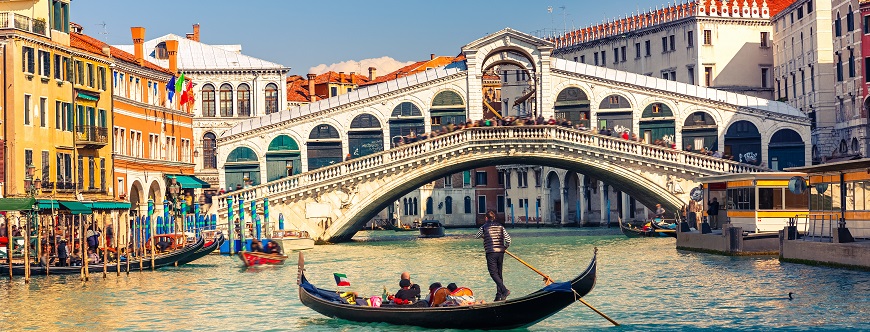
Historical pieces of evidence suggest that refugees founded Venice. When Germanic tribes ravaged northern Italy in the 5th century, many mainlanders escaped to this difficult-to-access area on the Adriatic Sea. Over the centuries, the refugee community grew into the most powerful trading port in the Mediterranean. At its peak, Venice counted 3,000 trade ships and 300 navy vessels. After Napoleon's fall, it became part of the Austrian Kingdom of Lombardy-Venetia, but after the uprising in 1848, the city reached its independence once again. Shortly after, in 1866, Venice was annexed to the Kingdom of Italy. 1932 saw the opening of the motor and rail bridge between Venice and the mainland, which led this city to come out on top as a tourist destination. It can be a bit hard to navigate around the city, but don't let that put you off, as this is part of Venice's charm. Leave the other tourists at St Mark's Square and the Rialto Bridge and explore the maze-like little neighbourhoods instead. The most interesting areas and islands are Cannaregio, San Polo/Santa Croce, Dorsoduro, San Marco, and Castello.
258,051 (2023)
1 Euro = 100 cents
Police: 112
Carabinieri Force: 113
Fire Brigade: 115
Emergency Medical Service: 118
Shops in Venice are usually open 9am–1pm and 3pm–8pm, with some variations depending on the time of year.


The best time to visit Venice is during the spring (April to June) and fall (September to November) when the weather is pleasant and the city is less crowded.
Must-see attractions in Venice include St. Mark's Basilica, the Doge's Palace, the Grand Canal, and the Rialto Bridge. Don't miss a gondola ride through the canals.
Three to four days in Venice are ideal to explore the main attractions, enjoy a gondola ride, and take a day trip to nearby islands like Murano and Burano.
The best way to get around Venice is on foot or by using the vaporetto (water bus) system, which connects various parts of the city and nearby islands.
In Venice, try local dishes like sarde in saor (sweet and sour sardines), risotto al nero di seppia (squid ink risotto), and bigoli in salsa (pasta with anchovy sauce).
Staying in the San Marco area offers proximity to major attractions like St. Mark's Square, while the Cannaregio district provides a more local experience.
In Venice, it's customary to greet with a friendly 'buongiorno' and to dress modestly when visiting churches. Avoid sitting on steps or bridges, as it's discouraged.